


Venice is one of those places where almost everything looks as though it has been there forever.
Stone buildings lean over canals. Bridges connect streets that seem too narrow to lead anywhere. Old façades sit directly against the water, marked by years of weather and tide.
And then, through all of it, everything moves.
Gondolas pass beneath bridges.
Water taxis disappear around corners.
Reflections break apart whenever a boat goes by.
Light moves across the buildings.
People appear at the end of an alley and are gone a few seconds later.
That contrast is what I remember most about photographing Venice.
The city feels ancient.
The photograph is often about something that lasts only a moment.
A city without normal streets
Most cities teach you how to move through them quite quickly.
There is usually some logic.
Roads.
Blocks.
Intersections.
Venice seems to have its own rules.
You can follow a narrow street thinking you know where it is going, cross a small bridge, turn another corner and suddenly find yourself beside a completely different canal.
Photographically, I love that.
You don't always need to arrive with a particular image in mind.
Sometimes walking is enough.
A gondola appears underneath a bridge.
A building catches the last light.
A reflection suddenly becomes perfectly still.
Then a boat passes through it and the photograph is gone.
Venice rewards paying attention.
The Grand Canal
Eventually, almost every journey through Venice seems to return to the Grand Canal.
It is one of the city's great visual contradictions.
The canal is incredibly busy, but the buildings surrounding it seem almost permanent.
Palazzos line the water.
Church domes and bell towers rise beyond them.
Gondolas, vaporetti and water taxis constantly move through the foreground.
The architecture stays.
Everything else changes.
Venice Evening
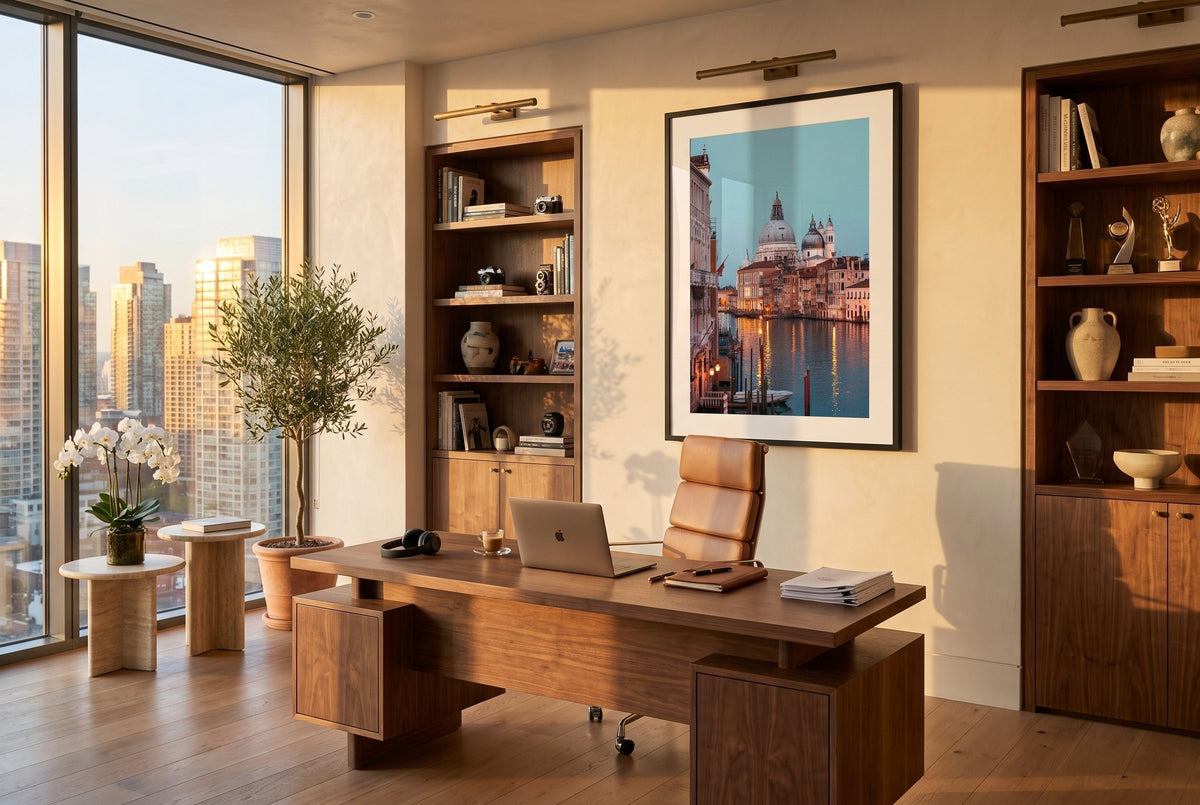
In Venice Evening, the Grand Canal becomes quieter as daylight begins disappearing.
The Basilica di Santa Maria della Salute sits in the distance while warm lights begin reflecting across the water.
This is the Venice I find particularly interesting to photograph.
Not completely day.
Not completely night.
There is still colour in the sky, but the city has started illuminating itself.

The reflections are almost as important as the buildings.
Without the water, you would have beautiful Venetian architecture.
With it, every light is repeated and stretched through the frame.
Venice never really gives you only one version of a scene.
There is the city above the water.
And another one underneath it.
The Rialto Bridge
The Rialto Bridge is one of those landmarks that you recognise immediately.
It has also been photographed from almost every possible angle.
That creates the same challenge I find in places like Mount Fuji or the Sydney Opera House.
The landmark itself isn't difficult to find.
The harder part is deciding what else belongs in the photograph.
In Venice Street Series 10, the Rialto Bridge sits behind one of the objects most closely associated with Venice: a gondola.
The bridge gives the photograph a location.
The gondola gives it a sense of place.

View Venice Street Series 10 →
I like that distinction.
A landmark can tell you where a photograph was taken.
The smaller details often tell you what it felt like to be there.
An old street lamp.
Wooden mooring poles.
Water moving underneath the bridge.
A gondola waiting in the foreground.
Sometimes those details are what stop a photograph becoming simply another view of a famous place.
Waiting for something to enter the frame
A lot of travel photography is about waiting.
Venice makes that particularly obvious.
You can find the composition first.
A bridge.
A canal.
Buildings on either side.
Good light.
Everything can already look right.
But sometimes the photograph still feels empty.
Then a gondola enters the canal.
Suddenly there is scale.
Movement.
A person.
A reason for your eye to travel through the frame.
That is what I like about Venice Street Series 9.
The Bridge of Sighs is an extraordinary piece of architecture, but the gondola travelling beneath it gives the photograph its moment.

A few seconds earlier, the scene would have been different.
A few seconds later, it would be different again.
The buildings have been there for centuries.
The photograph happened because of something passing through.
The smaller canals
The Grand Canal gets most of the attention.
But some of the Venice photographs I enjoy most happen away from it.
The smaller canals feel more intimate.
Buildings sit closer together.
Balconies hang above the water.
Windows, shutters and laundry become part of the composition.
And occasionally a gondola appears almost silently underneath them.
In Venice Street Series 4, the gondola occupies only a relatively small part of the scene.
The architecture surrounds it.

That is closer to how I remember walking through Venice.
You don't constantly stand in front of monumental landmarks.
Most of the time, you are moving through these smaller spaces.
A bridge.
A doorway.
A canal only a few metres wide.
A glimpse of somebody travelling through it.
Those quieter scenes often say as much about Venice as the famous views do.
When the reflection becomes the subject
Water changes architecture.
A building can be perfectly straight above the canal and completely distorted underneath it.
Colour stretches.
Windows disappear.
Shapes become abstract.
And if the water becomes still enough, sometimes the reflection is almost too perfect.
Venice Street Series 8 is one of those photographs where the symmetry of the building and its reflection becomes more important than any famous landmark.

There isn't a gondola dominating the frame.
There isn't a major monument.
It is simply a Venetian building sitting between two canals, doubled by the water below it.
I think photographs like this are important within a destination collection.
Not every image needs to announce where it was taken immediately.
Sometimes colour, architecture and atmosphere are enough.
Taking the colour away
Venice is naturally associated with colour.
Terracotta walls.
Green-blue water.
Warm stone.
Painted façades.
Red gondola interiors.
Golden evening light.
So photographing Venice in black and white can initially feel like removing one of the city's defining characteristics.
But it also reveals something else.
Venetian Arcades in Black and White
Beneath the arcades of the Doge's Palace, repetition becomes the photograph.
One arch leads into another.
Columns create rhythm through the frame.
The patterned stone floor pulls your eye towards the distance.
Without colour, there is very little to distract from the architecture.

View Venetian Arcades in Black and White →
The scene becomes about line, texture and symmetry.
It feels quieter.
And considering that St Mark's Square can be one of the busiest parts of Venice, I like that contradiction.
A busy place can still produce a quiet photograph.
Looking up at the Doge's Palace
The same thing happens with Palazzo Ducale in Black and White.
Instead of trying to photograph the entire Doge's Palace as a landmark, the camera looks upwards from one corner.
The arches, columns and Venetian Gothic details become increasingly important as the building rises through the frame.

View Palazzo Ducale in Black and White →
Sometimes photographing architecture means stepping backwards until you can fit everything in.
Other times, the better answer is to move closer.
Once a building becomes familiar enough, you don't necessarily need to show all of it.
A fragment can say enough.
Venice changes with the light
Venice also makes you pay attention to light differently.
There are so many narrow canals and tall buildings that direct sunlight doesn't reach everything at once.
One façade can be glowing while the canal beneath it remains dark.
A few streets away, another building might be completely in shadow.
Then in the evening, the relationship changes again.
Street lamps appear.
Restaurants begin glowing.
Light reflects from windows onto the water.
The city becomes softer.
That is what makes photographing the same canal at a different time worthwhile.
The architecture may not change.
The photograph can.
Getting lost is part of photographing Venice
There are places where I want to know exactly where I am going.
Venice isn't really one of them.
Some of the most interesting streets are the ones you didn't intend to walk down.
A wrong turn can lead to a small bridge.
The bridge can lead to a canal you hadn't seen before.
And somewhere inside that sequence there may be a photograph.
Travel photography can become too focused on lists.
Photograph this landmark.
Go to this viewpoint.
Stand in this exact position.
There is value in planning, especially when light matters.
But Venice also reminds me why wandering with a camera is useful.
You leave space for the place to give you something you weren't looking for.
Why Venice keeps producing photographs
Venice is actually quite a small place compared with many cities I photograph.
Yet visually, it feels almost endless.
Part of that comes from the canals.
Every bridge gives you a new viewpoint.
Every reflection creates another version of the architecture.
Every boat changes the composition.
Then there are the details.
Arches.
Windows.
Weathered walls.
Doors opening directly onto water.
Striped mooring poles.
Street lamps.
Gondolas appearing between buildings.
You can photograph the grand version of Venice.
And then walk five minutes and photograph something almost completely abstract.
That variety is what makes the city more interesting to me than simply collecting its famous landmarks.
Which Venice photograph works best in your space?
The Venice collection ranges from colourful canal scenes to much quieter architectural photographs, so there are a few different directions to take.
If you want something immediately recognisable as Venice, Venice Street Series 10 combines the Rialto Bridge, gondola and Grand Canal within one composition.
Venice Evening is softer and more atmospheric. The cooler evening sky and warm lights reflecting through the canal make it particularly suited to interiors where you want colour without something overly bright.
For a more intimate version of the city, Venice Street Series 4 focuses on one of the smaller canals and feels less like a landmark photograph.
Venice Street Series 8 is more architectural, with symmetry and reflection doing most of the work.
And for contemporary or minimal interiors, Venetian Arcades in Black and White and Palazzo Ducale in Black and White remove the familiar Venetian colour completely and allow the architecture to become the subject.
The best choice depends on what Venice means to you.
The landmarks.
The canals.
The architecture.
Or simply the feeling of walking around a city unlike anywhere else.
From Venice to your wall
The Venice photography collection moves between the Grand Canal, Rialto Bridge, Bridge of Sighs, gondolas, smaller waterways and the architecture surrounding St Mark's Square.
Some photographs capture Venice exactly as most people remember it: warm colour, water and historic buildings.
Others reduce the city to reflection, repetition, shape and light.
Every photograph was captured by Peter Yan and is available as a made-to-order framed artwork, printed using archival materials and hand-framed in Australia.
The pieces are available with black, white and natural oak framing, from smaller works through to large statement sizes.
Venice has existed for centuries.
But when I think about photographing it, I remember the things that didn't stay still.
A gondola passing beneath a bridge.
Light disappearing from a building.
A reflection breaking apart on the water.
Those moments lasted seconds.
The photographs are what remained.
Explore the complete Venice photography collection →
Choosing Venice for a living room or hallway? Our guide to Italy and Amalfi Coast photography prints for the home walks through colour, scale, and where Venice sits beside Florence, Amalfi, and the Dolomites.