


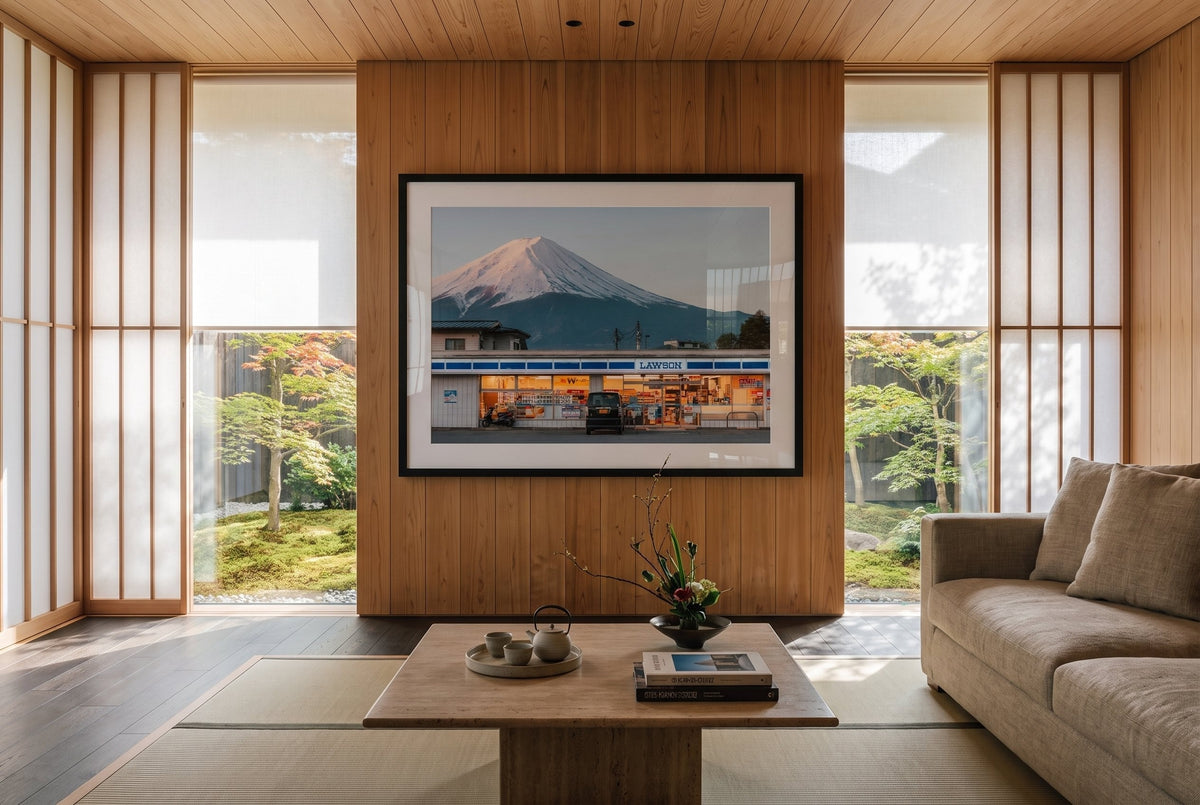
Mount Fuji might be one of the easiest mountains in the world to recognise.
That doesn't make it easy to photograph.
The first time you see Fuji clearly, there is an instinct to point the camera directly at it.
I still do that.
But after photographing the mountain in different seasons, different light and from different parts of the surrounding towns, I realised something.
My favourite photographs of Mount Fuji are rarely just photographs of Mount Fuji.
There is usually something else.
A convenience store.
A Shinkansen.
A quiet street.
Cherry blossoms.
Autumn leaves.
Powerlines.
A car.
Something ordinary that gives the mountain a sense of place.
Fuji is the constant.
Everything happening around it is what changes.
Waiting for Fuji to appear
One thing photographs don't show very well is the waiting.
Mount Fuji can be enormous and still somehow disappear completely.
Cloud moves across the mountain quickly. A clear view can turn into nothing within minutes, and sometimes the opposite happens.
You can wait looking at an empty sky and suddenly the clouds separate enough for the summit to appear.
Those moments have changed the way I photograph Fuji.
There isn't much point forcing it.
Sometimes you wait.
Sometimes you return.
Sometimes the conditions simply don't happen.
And occasionally everything lines up for a few minutes.
That uncertainty is part of what makes photographing Mount Fuji interesting to me.
If the mountain were perfectly visible every time, I suspect the photographs wouldn't feel quite as rewarding.
Mount Fuji and Lawson
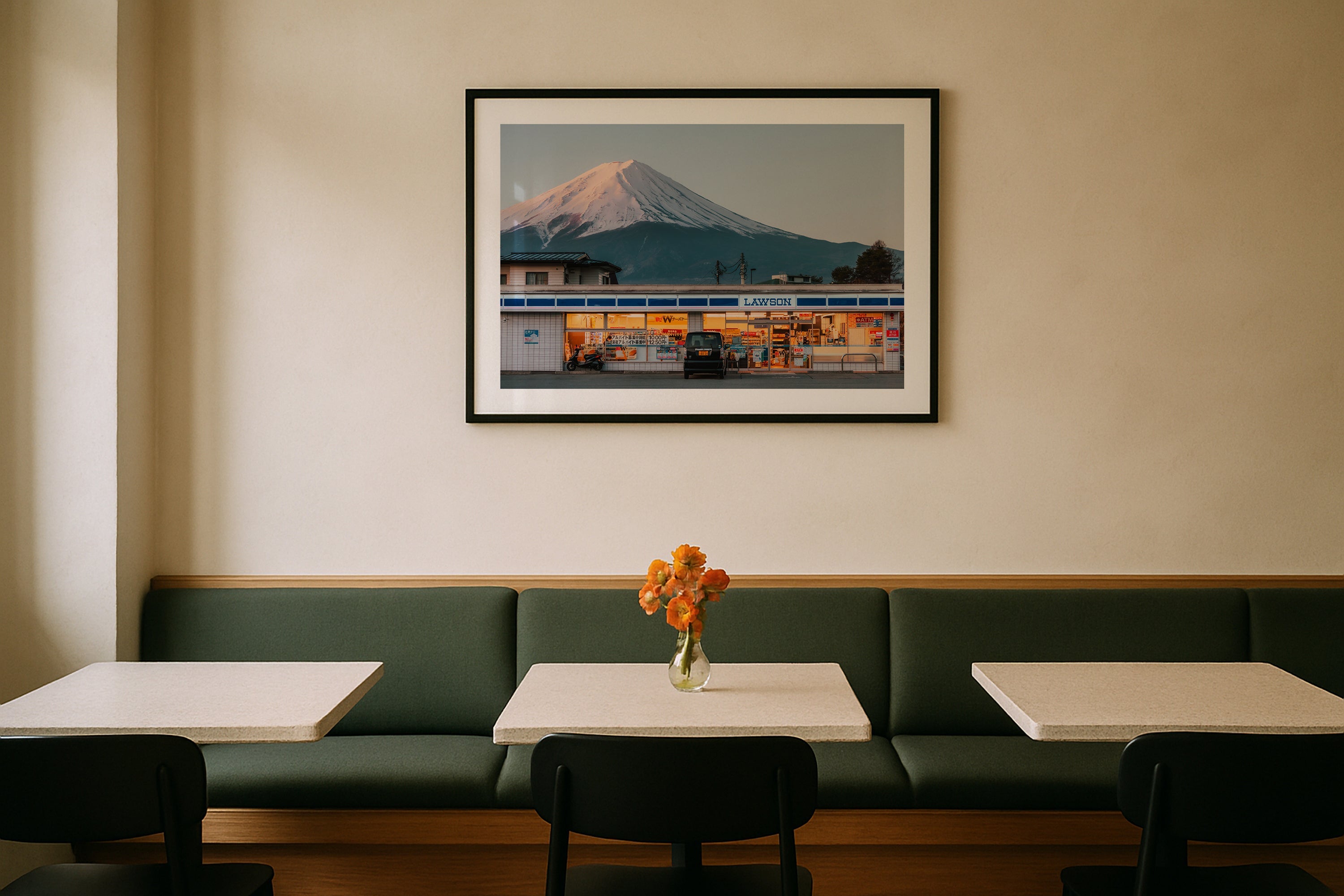
One of the photographs I am most associated with now combines Mount Fuji with something considerably less dramatic.
A Lawson convenience store.
On paper, it is a strange combination.
You have one of Japan's most important natural landmarks rising behind fluorescent signs, vending machines, parked cars and an ordinary neighbourhood convenience store.
But that contradiction is exactly what interested me.
Mt Fuji Lawson Sunrise
In Mt Fuji Lawson Sunrise, the mountain dominates the background while the Lawson store sits directly below it.
The photograph has become one of the most collected works in the studio, but what I still like about it is how normal everything underneath Fuji feels.
People living around Kawaguchiko see convenience stores, roads and powerlines every day.
Then they look up and Mount Fuji is there.
There is something very Japanese about that relationship between the extraordinary and the everyday.

Sunrise also gives the scene a particular calm.
The store is already illuminated, but the surrounding town hasn't fully come alive yet. Fuji catches the early light while everything beneath it remains comparatively quiet.
A few hours later, it would be the same mountain and the same building.
It wouldn't be the same photograph.
The same Lawson at blue hour
I returned to the Lawson idea in different light because the relationship changes once the sun disappears.
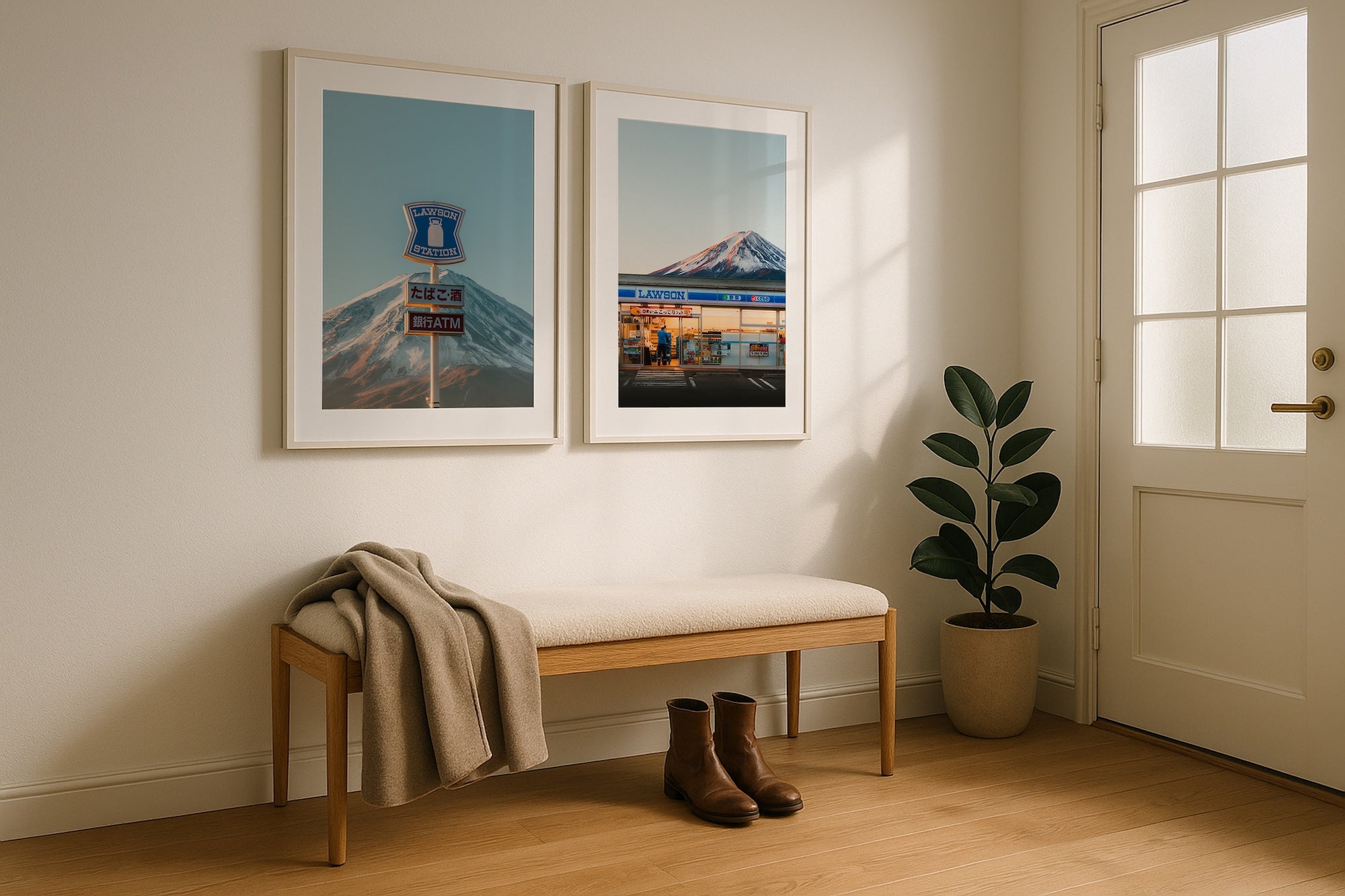
In Mt Fuji Lawson Blue Hour, artificial light becomes much more important.
The Lawson signage begins glowing against the cooler surroundings while Fuji becomes softer in the distance.
That small shift changes the mood completely.
The sunrise version feels like the beginning of a day.
Blue hour feels more cinematic.

View Mt Fuji Lawson Blue Hour →
This is one of the things I enjoy about returning to the same subject.
There isn't always a need to find somewhere completely new.
Sometimes the photograph is already there.
You simply haven't seen it in the right light yet.
The Shinkansen and Fuji
If Lawson represents the everyday side of Japan, the Shinkansen represents something completely different.
It is difficult to think of two symbols that say Japan more clearly.
Mount Fuji has been part of the landscape for thousands of years.
The Shinkansen passes through it in seconds.
Putting the two into the same frame creates a contrast I find fascinating.
Mt Fuji Shinkansen
In Mt Fuji Shinkansen, the train is relatively small.
That is intentional.
I didn't want it to compete with the mountain.
I wanted it to show scale and movement.
Fuji barely appears to change.
The train disappears almost immediately.
The photograph happens in the fraction of a second when the two line up.

It is a photograph about Japan, but also about time.
Something permanent.
Something moving incredibly quickly.
For one moment they occupy the same frame.
Then the train is gone.
Fuji at the end of a street
One of my favourite ways of photographing Mount Fuji is from places that initially look completely ordinary.
Honcho Street is a good example.
You have shops, signs, cables, roads and buildings leading towards the mountain.
Nothing about the foreground is trying to be picturesque.
That is precisely why I like it.
Mt Fuji Honcho Street doesn't separate Fuji from daily life.
It places the mountain inside it.

View Mt Fuji Honcho Street II →
The street creates natural lines that pull your eye towards the mountain, but the urban details are just as important.
Without them, it would simply be another photograph of Fuji.
With them, there is a sense of actually standing somewhere in Japan and looking towards it.
Those kinds of photographs often mean more to me than perfectly clean landscape compositions.
Travel rarely looks perfectly clean.
There are signs.
Cars.
Cables.
People.
Buildings.
Sometimes those things aren't distractions.
They are the photograph.
Mount Fuji in spring
Then sakura arrives and Fuji changes again.
The mountain itself obviously hasn't moved, but cherry blossom gives the landscape an entirely different feeling.
Everything becomes softer.
Branches frame the snow-covered peak while pink and white flowers fill areas that would otherwise be open sky.
In Mt Fuji Sakura, there are two subjects that people immediately associate with Japan within the same photograph.
That could easily become too obvious.
The challenge is making one support the other rather than simply putting two icons together.

For me, the cherry blossoms work best when they feel like part of the landscape rather than decoration placed around the mountain.
Their temporary nature is also important.
Fuji feels permanent.
Sakura lasts for such a short period.
That contrast is part of what makes seeing them together special.
Then autumn changes everything again
A few months later, the colours are completely different.
Instead of pale blossom, there are deep reds, oranges and yellows.
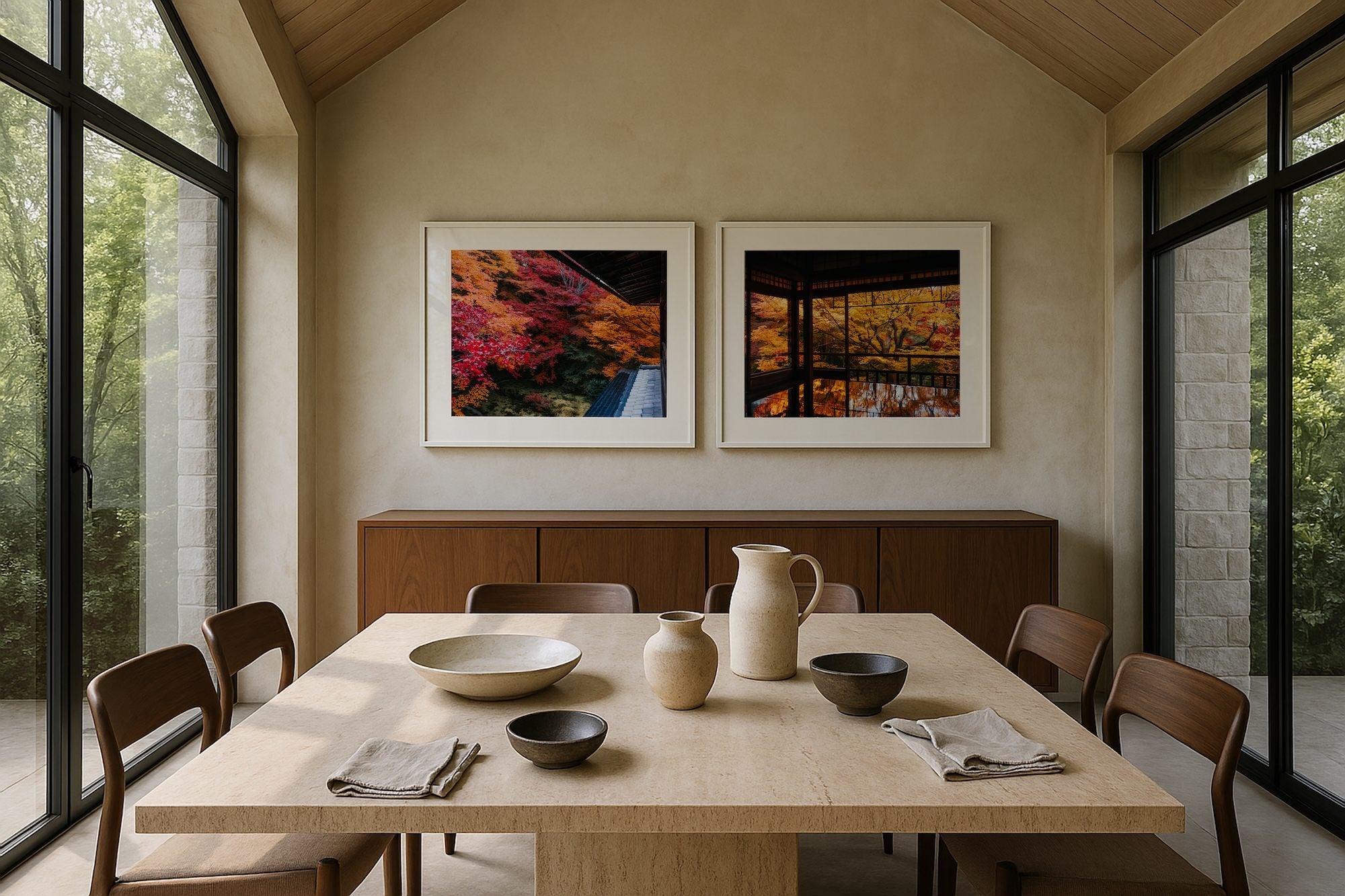
Mt Fuji Under the Maple Tree uses autumn foliage to frame the mountain in a much warmer way.
The resulting photograph feels completely different from the cleaner blue-and-white Fuji images.

View Mt Fuji Under the Maple Tree →
This is one reason I don't think of Mount Fuji as a single photographic subject.
There isn't one definitive version.
Fuji in spring isn't Fuji in autumn.
Sunrise isn't blue hour.
A clear winter morning isn't a cloudy summer afternoon.
The mountain gives you a reason to return because everything around it keeps changing.
Sometimes Fuji should be simple
Not every photograph needs a convenience store, train or seasonal foreground.
There are moments when the mountain itself is enough.
At sunrise, with clean light and very little competing for attention, Fuji can become almost graphic.
A triangular shape.
Snow.
Sky.
Layers of landscape underneath.
The Mt Fuji Sunrise photographs are much quieter than much of the rest of the collection.
And I think that is important.
If every photograph relied on an unusual foreground or recognisable Japanese object, the collection would start becoming predictable in a different way.
Sometimes simplicity is the thing that feels different.

The famous view isn't always the photograph
Mount Fuji has become even more photographed in recent years.
Certain viewpoints spread quickly through social media.
People see a photograph online, travel to the exact location and try to create the same frame.
I understand it.
Some views become famous because they genuinely are remarkable.
But I think the most interesting part begins once you have taken that obvious photograph.
Turn around.
Walk further.
Come back later.
Wait until the light changes.
Look at what everybody else is ignoring.
The photograph you planned might be good.
The one you didn't know existed is often better.
That has happened to me repeatedly around Fuji.
I might arrive thinking about the mountain and leave thinking about a tiny person, a passing train, an unexpected street or the way autumn leaves happened to frame the peak.
Fuji gets you there.
Everything else creates the photograph.
Why I keep photographing the same mountain
There are thousands of mountains in the world.
I have photographed many of them.
But there is something unusual about Mount Fuji.
Part of it is obviously the shape.
It is extraordinarily clean and recognisable.
Part of it is cultural.
Fuji appears everywhere in Japan, from traditional art to advertising, souvenirs and everyday life.
But photographically, what keeps bringing me back is that the mountain is incredibly consistent while the world underneath it isn't.
The convenience store changes.
The train arrives.
People walk through the frame.
Leaves change colour.
Cherry blossoms appear and disappear.
Weather moves through.
Fuji stays where it is.
That gives you endless ways of telling a different story with essentially the same subject.
I don't think I have finished photographing it.
I'm not sure there is really a point when you can.
Which Mount Fuji photograph works best in your space?
The Mount Fuji photographs in the Japan collection range from very minimal landscapes to photographs filled with urban details, so choosing one often comes down to how prominently you want the artwork to speak.
For something iconic and contemporary, Mt Fuji Lawson Sunrise is the natural starting point. The blue Lawson signage introduces colour while the mountain keeps the composition grounded.
Mt Fuji Lawson Blue Hour is moodier, with cooler tones and more emphasis on artificial light.
If you prefer cleaner compositions, Mt Fuji Shinkansen combines two recognisable Japanese subjects without feeling visually crowded.
The Mt Fuji Sunrise photographs, including Sunrise II, are quieter again and work well in interiors where you want the landscape to have space around it.
For something warmer, Mt Fuji Under the Maple Tree introduces autumn colour, while the Mt Fuji Sakura works, including Sakura II, have a softer spring palette.
And if you like photographs that feel more connected to everyday Japan, the Honcho Street and Lawson series show Fuji as part of a town rather than an isolated landscape.
There isn't one version of Mount Fuji that I consider the definitive photograph.
That's probably why there are so many of them.
From Mount Fuji to your wall
These Mount Fuji photographs were captured around the Fuji Five Lakes region and other viewpoints across Japan, from sunrise landscapes and seasonal scenes to the Lawson, Shinkansen and Honcho Street series.
Every photograph is available as a made-to-order framed artwork, printed using archival materials and hand-framed in Australia.
Black, white and natural oak frame options allow the same photograph to sit very differently within a room.
There is something I like about that journey.
A photograph might begin with waiting for cloud to move somewhere beneath Mount Fuji.
Then, eventually, that fraction of a second becomes something hanging on a wall thousands of kilometres away.
And perhaps that is the real reason I keep photographing Fuji.
The mountain stays the same.
The moments around it never do.
For a practical look at Fuji versus Tokyo, sizes, and where to start, see Japan framed photography prints.
Explore the Mount Fuji photography in the Japan collection →