


New York is one of the hardest cities to simplify.
Almost everywhere you point a camera, something else enters the frame.
Another building.
Another window.
Another sign.
Another street disappearing between towers.
Even when you find the Empire State Building, there are hundreds of other buildings competing with it.
At first, that can feel like a problem.
Eventually, I realised it was the reason I enjoyed photographing New York.
The city doesn't really give you an empty frame.
You have to decide what to do with everything that is already there.
Seeing Manhattan from above
At street level, New York can feel almost impossible to understand.
Buildings block the horizon. Streets become corridors. You know Manhattan is enormous, but you only ever see a small part of it at a time.
Then you get above it.
Suddenly the grid appears.
Blocks line up.
Avenues stretch through the city.
Buildings that felt enormous from below become part of a much larger pattern.
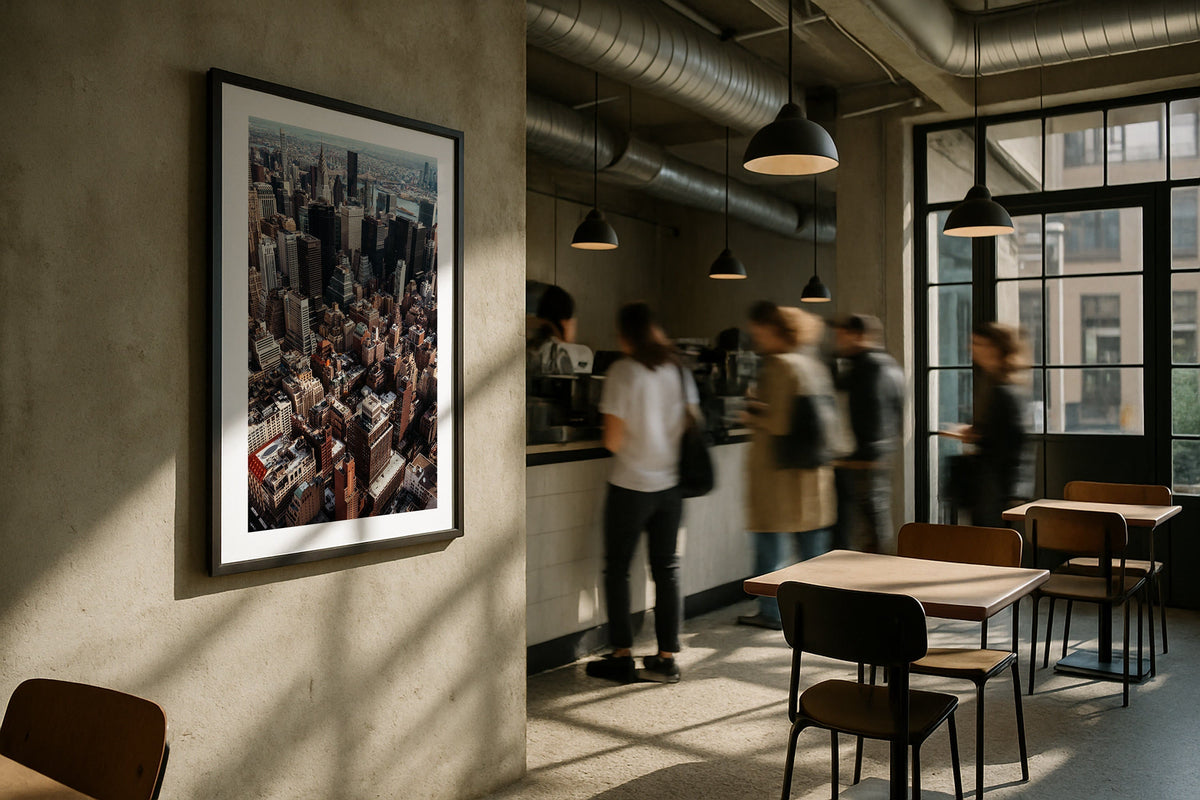
That shift in perspective is what interested me in New York City 'Metropolis Melodies'.
From above Midtown Manhattan, the photograph isn't really about one particular skyscraper.
It is about all of them.
The density is the subject.

View New York City 'Metropolis Melodies' →
There is almost nowhere for your eye to rest, and I like that.
Trying to make New York look quiet would miss something fundamental about the place.
Sometimes the photograph should feel as busy as the city does.
The buildings inside the city
New York has a strange relationship with scale.
One building can be famous enough to recognise instantly.
Yet move further away and even that building becomes one small part of Manhattan.
The Empire State Building is probably the clearest example.
From nearby, everything leads towards it.
From much higher up, it becomes one vertical shape within thousands of others.
Both perspectives tell a different story.
The Empire State Building in black and white
Colour can sometimes make New York even more complicated.
There are advertisements, yellow taxis, different materials, lights and reflections everywhere.
Removing colour changes what you notice.
In Empire State Building in Black & White, the architecture takes over.
The shape of the building becomes more important than everything happening around it.

View Empire State Building in Black & White →
There is something appropriate about photographing New York this way.
So much of the visual history of the city already exists in black and white.
It immediately feels less tied to one particular year.
The city becomes lines, shadows and buildings rather than colour.
Stepping further back
In New York City in Black & White Series: IV, the Empire State Building is still important, but it doesn't stand alone.
The wider aerial view reveals the density surrounding it, with Manhattan continuing towards One World Trade Center in the distance.
The landmark gives your eye somewhere to start.
Then the rest of the city takes over.

View New York City in Black & White Series: IV →
That is often how New York feels to photograph.
You begin with one subject.
Then you notice everything around it.
The photograph gets better when those things start working together rather than when you try to remove them.
The New Yorker
Not every New York photograph needs the skyline.
Sometimes one sign can say enough.
The New Yorker is built around the glowing New Yorker Hotel sign surrounded by Manhattan architecture.
I like photographs where words become part of the composition.
Normally a sign is something you might try to avoid.
Here, it is the reason for the photograph.

The letters immediately establish a place, but the buildings surrounding them prevent the image from becoming simply a photograph of a sign.
It feels embedded within the city.
And that is something New York does particularly well.
Its identity appears everywhere.
On buildings.
Street signs.
Taxis.
Subway entrances.
Fire escapes.
Even without showing one of the traditional landmarks, the city has a visual language that is difficult to mistake for anywhere else.
New York before it fully wakes up
For all the energy associated with Manhattan, some of my favourite moments happen when the city is quieter.
Sunrise gives New York a completely different atmosphere.
The light becomes softer.
The skyline separates into layers.
The warmth on the buildings contrasts with the cooler water around Manhattan.
And for a short period, the city that normally feels relentlessly busy can almost appear still.
Downtown Manhattan Sunrise
In Downtown Manhattan Sunrise, Lower Manhattan stretches towards One World Trade Center beneath warm early light.
From this distance, the individual streets disappear.
The city becomes a shape.

View Downtown Manhattan Sunrise →
It is the opposite of being inside Manhattan.
On the street, everything feels close.
From here, the entire city seems to sit within the landscape.
The same skyline, a different frame
Downtown Manhattan Sunrise II approaches the same part of New York differently.
The wider composition gives the skyline more space and brings more of the surrounding water into the photograph.

View Downtown Manhattan Sunrise II →
I think this is an important part of photographing somewhere more than once.
The subject doesn't always need to change.
Sometimes you move.
Sometimes the light changes.
Sometimes you simply realise that the first photograph wasn't the only photograph.
One place can keep producing different compositions if you give yourself enough time to look.
When colour becomes unnecessary
New York is one of the few cities where I find myself repeatedly returning to black and white.
Part of that comes from the architecture.
There is so much structure already present that colour isn't always necessary.
Rows of windows.
Straight avenues.
Water towers.
Art Deco details.
Glass towers beside older brick buildings.
In black and white, those differences become more obvious rather than less.
The photograph stops being about what colour New York was on that particular day and becomes more about the shape of the city.
That is why several photographs in the collection exist without colour.
They feel quieter.
But they don't necessarily feel less like New York.
Sometimes they feel more like it.
A city everyone has already seen
Photographing New York has the same problem as photographing Mount Fuji, the Sydney Opera House or Positano.
Everybody already knows what it looks like.
New York may be even more difficult because we have seen it constantly in films, television, advertising, magazines and photography.
There are images of the Empire State Building before most of us ever visit the city.
There are familiar views of Manhattan that feel like memories even when they aren't ours.
So the challenge isn't simply finding the landmarks.
It is finding your own relationship with them.
Maybe that means moving higher.
Getting closer.
Removing colour.
Photographing at sunrise.
Or concentrating on a sign rather than the entire skyline.
I don't think originality in travel photography always means discovering something nobody has ever photographed.
Sometimes it means standing in front of something everybody has seen and still paying enough attention to make your own photograph.
Why New York works so well in photographs
There are cities where you need to search for visual structure.
In New York, structure is everywhere.
The grid creates it.
The architecture creates it.
The scale creates it.
Even the spaces between buildings create lines through the frame.
That makes New York incredibly generous photographically, but also demanding.
There is almost always too much.
The photograph comes from deciding what matters.
Sometimes it is one building.
Sometimes an entire skyline.
Sometimes a tiny sign surrounded by skyscrapers.
And sometimes it is the density itself.
New York doesn't need to be made visually interesting.
The harder job is knowing where to stop.
Which New York photograph works best in your space?
The New York collection ranges from warm skyline photographs to much more graphic black-and-white architecture.
If you want something that captures the scale and intensity of Manhattan, New York City 'Metropolis Melodies' is the strongest starting point. The aerial perspective fills the frame with architecture and works particularly well as a larger statement piece.
For something more iconic and minimal, Empire State Building in Black & White places the focus firmly on one of New York's most recognisable buildings.
New York City in Black & White Series: IV is wider and more complex, making it a good option if you want the Empire State Building to sit within the larger Manhattan skyline rather than dominate it.
For warmer interiors, the Downtown Manhattan Sunrise photographs, including Sunrise II, bring softer colour and more open space into the collection.
And The New Yorker is different again. It feels less like a traditional skyline photograph and more like a piece of New York itself.
The right photograph depends on which part of the city you respond to.
The scale.
The architecture.
The skyline.
Or simply the feeling of being somewhere that never seems completely still.
From New York to your wall
The New York collection includes original photographs of Manhattan, the Empire State Building, Lower Manhattan and some of the architectural details that make the city instantly recognisable.
The collection moves between warm sunrise photography, aerial cityscapes and black-and-white architectural work.
Each photograph is available as a made-to-order framed artwork, printed using archival materials and hand-framed in Australia.
Black, white and natural oak frame options allow the same New York photograph to take on a very different character once it enters a room.
Maybe that is what I like most about photographing cities like this.
New York is enormous.
The photograph isn't.
You reduce millions of windows, streets, buildings and moments into a single frame.
And somehow, if you get it right, it can still feel like New York.